Thursday, August 13, 2009

Future Sports Stadiums


The stadiums of today are constructed to show the teams past and provide the fans with plenty of entertainment and refreshments. The big screen at stadiums keep the fans entertained at games by playing video games or asking trivia questions during a break in the game. Concession stands are all over in every park most stadiums even have vendors walking from seat to seat. The new stadiums will be much more technologically advanced. Cisco Field, the future home of the Oakland Athletics is scheduled to open in just a few years and it is going to make good use of advances in technology. A ticket kiosk will scan your ticket and offer seat upgrades if there are any available. Fans will also be asked if they would like any merchandise or refreshments which will be delivered to their seats and they can pay for all of it right at the kiosk. After all the orders are placed directions will be given to your seat. All stadiums will offer free wifi to all those in attendance and allow them to view extra news about the team.

The Future of Sports Medicine


The rate in which athletes recover today is remarkable. Players are in surgery one week and competing the next. The future of sports medicine won't just focus on short term procedures that fix an injury, the new sports medicine will focus on preservation. In a few short years stem cells will be injected in the joints, cartilage, and tendons in athletes as a way to maintain their health and prolong their careers. Over time their joints weaken and their cartilage and tendons wear down, but an injection of stem cells will fix that problem and prevent it from happening. In injuries such as a torn ACL or a torn rotator cuff stem cells would help regenerate tissue and fix the damaged tissue whereas if no stem cell shot is given it would be unlikely that the damaged tissue would repair itself. Some athletes have even already had their own stem cells frozen in case the day comes when they will be able to use this technology to help themselves heal faster. With this advance in medicine there is also a down fall. Athletes could use stem cells in the same way that steroids are used. The injected cells would help the body regenerate its cells faster which is what steroids do, this allows the athlete to train harder and gain muscle mass. With the stem cells it would also be almost undetectable because they would be using their own cells it would be as if there was nothing unnatural about it.

Future salaries of professional athletes


Record breaking contracts are signed on a yearly basis; this year during tough economic times in which millions have lost their jobs and houses the Yankees spent $423.5 million in the off season to sign three players. This is a clear indication that the amount of money an athlete receives will not be going down. With ticket and concession prices continuing to climb year after year and merchandise for all of professional sports selling at steady rates more money will be available to give to the athletes. New stadiums being built are bigger than ever, they will be able to hold more people which means there will be more people to pay for parking, concessions, and souvenirs. This means that the teams and sports leagues will make more money and that money will go to the players. Athletes will also continue to make money through endorsement deals, and as sports leagues continue to expand and play in other countries the opportunity for endorsement deals will increase.

Video Games of the Future


Future sports video games will be far more interactive than anything that is available now. The Nintendo Wii opened the door for a whole new level of gaming that is perfectly suited towards sports. Allowing gamers to control the game through their movements will be far better than pressing buttons. Pretty soon sports games will have people run in place in order to run in the game and actually try to shoot a basketball or catch a line drive. It will be very similar to actually playing in real life, many game will be able to be played in a first person view and it will take real time reactions in order to be good at the games. Online versions of the game will almost be like playing a pick up game with someone in China, California, or Germany.

Monday, August 10, 2009

Future of racing


Will this be the future of racing? I sure hope so. Light cycles speeding through futuristic cities will eventually replace traditional motorcycle racing. We might even give it a little "Tron" twist and players will lose if they hit the other players trail. I wonder how long it will take for this to become reality.

Source:
video- www.youtube.com

Golf on the moon


How much would you pay to play some golf on the moon? Sports may radically change if we ever decide to colonize the moon. No doubt it would cost a huge amount of money if new technology isn't developed but businesses might be able to make money from citizens eventually. Once space travel gets perfected we can start to make moon bases and colonies. Then businesses can charge people to go to the moon and let them play some golf. I'm sure it would be a lot harder because of the reduced gravity but it should be fun nonetheless.

Future of baseball?


Will baseball, or any sport for that matter, eventually become played by robots? I don't think human athletes will ever be replaced but robots may be used in some new types of sports. Instead of athletes, computer programmers will compete to program robots to play any kind of sports. Kind of like the show "Robot Wars" but with fully programed computers that aren't remote controlled. These teams of robots can compete with a different team of robots programmed by a different group of programmers.

Source:
video - www.youtube.com
http://www.popsci.com/scitech/article/2009-07/does-baseballs-future-lie-their-cold-robotic-hands

Zero gravity sports


In the very distant future, there is no doubt that sports will still be around. I think that advancements in technology will eventually lead space into zero gravity environments. This will add a whole new perspective on the way sports is played. I can see many different sports being played in zero gravity such as football, tennis, and a type of basketball. Zero gravity will surely add a whole new dimension to these sports. There is also limitless opportunity to invent new games. Just think about it, athletes no longer have to be weighted down by gravity and can take their game playing to a whole 'nother level. But gliding around a zero gravity room and throwing around a ball is harder than it seems. Players are going to have to plan all of their moves in order to get to the ball, or anyplace they need to be. Once you bounce off the wall, your course is set and you cant change course until you hit another wall. This adds a whole new level of strategy into the games. The balls are going to have to be light so that less momentum transfers to the player when they hit it. Zero gravity games are definitely going to be hit once the time comes around but it won't be anytime soon.

Source:
http://www.spacefuture.com/tourism/sport.shtml

Thursday, August 6, 2009

NASCAR Tire Development - A Look Ahead


The Indianapolis Raceway was resurfaced before the 2008 Brickyard race, this caused the tires used to wear down after about 10 laps and caused serious safety concerns. This lead to Goodyear re-examining their methods of developing and testing tires. An optical scanner was brought in by Goodyear to study the surface of the track. The use of the optical scanner to approach the problem from another angle not only lead to better tires being developed for the Indianapolis Raceway but opens the door for optical technology to be used in the development of tires for everyday use. A better understand of road surfaces will help in the development of safer tires for all vehicles. The cycle of raceway developments making their way to everyday road use continues.


References:

Website / Photo: Yahoo.com - 'Unprecedented' effort has led Goodyear back to Indy: http://sports.yahoo.com/nascar/news?slug=nascar_com-enterprise.inside.nascar.goodyear.indianapolis-20090722&prov=nascar_com&type=lgns

NASCAR Sponsorship - A Look Ahead


NASCAR, one of the richest sports, is looking for new ways to generate revenue with creative sponsorship. Looking beyond the sponsorship of cars and their drivers, NASCAR now has track / race name sponsorship. The newest sponsorship is from ServiceMaster Clean in the form of a sponsored yellow flag (yellow flags are used to tell drivers there is a hazard on the race track) in addition when the hazard (which could be trash or an accident on the track) needs to be cleaned up, yellow ServiceMaster Clean cars/trucks will come out to cleanup. This type of sponsorship is a first for NASCAR and signals a new thinking in out to generate revenue. Not only will these types of creative sponsorship help NASCAR remain competitive in tight economic times but allow for new sponsors to display their products to NASCAR fans. Exposing fans to products they made not be aware of will allow for smaller companies which may not be able to afford the costs of full car/team sponsorship to get their products notice by race watching public.


References:

Website: NHLOutsider - Creativity Key In Securing Newest NASCAR Sponsorship For Yellow Flag Cautions: http://bleacherreport.com/articles/111717-creativity-key-in-securing-newest-nascar-sponsorship-for-yellow-flag-cautions
Photos: Sportztoday.com - NASCAR: http://www.sportztoday.com/nascar/

NHL Goalies Masks - A Look Ahead


The primary function of the goalie mask is to provide protection for the goalie's face. Made from new energy resistance materials like fiberglass and Kevlar, the goalie mask has taken on another role, that of self expression for the goalie. This is best summed up in a quote from Toronto artist Dave Arrigo: "The goalie mask is a billboard to that player's soul". The use of the goalie mask as a form of self expression is a growing trend in the NHL. These works of art give the goal a way to standout and connect with fans on a more personal level. Skilled artists are being used to create the look and feel of the goalie mask art work.


References:

Website: NHLOutsider - The Art of an NHL Goalie Mask: http://mvn.com/outsider/2009/02/post-2.html
Photos: Flyershistory.net - Flyers Goalie Mask Gallery: http://www.flyershistory.net/cgi-bin/gm.cgi

Fighting in the NHL - A Look Ahead


In a game that features big fast players making crushing hits on the opposing player, tempers will flare and fights will breakout. General Managers will continue to try and curb fighting in the NHL and at least on the surface appear to clean up the game of hockey. The fact of the matter is fighting in the NHL is a point of attraction for many fans and fights help to sell tickets. Many news and web sites feature fights in the NHL as top stories and show video of the fights over and over. Society has voted and fighting will survive in the NHL for the years to come. The challenge of the General Managers is not to stop fighting but to keep it clean and balance protecting their investment in their player with meeting the demands of the fans.


References:

Website: ESPN.com - NHL general managers weigh in on fighting: http://sports.espn.go.com/espn/wire?section=nhl&id=3967982
Photos: SportsClimax.com - NHL enforcer Boulton talks about fight rules: http://sportsclimax.com/tag/atlanta-thrashers/

Friday, July 31, 2009

Swimming Like Phelps


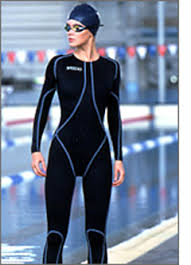
Swimming in the buff, the athletes of ancient Olympics believed clothes were a hindrance on performance. Modern technology, however, has changed that. Notably in swimming, the right suit can have an enormous impact. Introduced in February, Speedo's LZR swimsuit, 38 of the 42 world swimming records have been broken since then have fallen to swimmers wearing these suits. Some of those records have been claimed by less-than-notable racers, suggesting that the difference lies in the apparel, not the athlete.

The new suit is cut from a densely woven nylon-elastane material that compresses the wearer's body into a hydrodynamic shape but is extremely light. Moreover, there are no sewn seams. The first fully bonded bodysuit. The suit is ultrasonically welded, creating a smooth streamlined surface. Built with a core stabilizer, the suit holds the swimmer in a corset-like grip allowing to maintain the best body position in the water.

Sources:
Video - "How the Speedo LZR swim suit works"
http://blogs.howstuffworks.com/2008/04/21/how-the-fastest-swim-suit-works/
http://www.speedo80.com/lzr-racer/features/

The New Running Essential


What better companion then the Nike+. From the manufacturers who bring you the best running sneakers, not only help improve your running performance but now help you reach your personal goals. A partnership with Apple Inc, and their iPod technology comes a new technology for today's runner.

For only $29, you can add a running-oriented workout machine to your iPod. Allowing you to keep track of distance, pace and calorie data from your workouts. Once synced with Apple's own iTunes software, your data can be displayed showing you a summary of workouts. Sending your information to NikePlus.com transfers your data where you and all your friends can see your progress, help setting goals and keeping track of total mileage.

In addition, the software behind the device is what makes it so user-friendly. Allowing you to select your type of workout, such as, by distance, time, calorie count or an open-ended run. All while listening to your favorite playlist to help you push that extra mile. An extra feature built-in is the voiceover which counts down your time or distance remaining, which is a bonus encouragement.

Sources:

Photo - http://atjoburg.net/wp-content/uploads/2008/05/resize_article_photophp.jpeg

http://www.businessweek.com/technology/content/jan2007/tc20070102_855465.htm

Tuesday, July 28, 2009

Medical Technology in Today's Sports


Sports medicine has grown tremendously over the past 20 years along with people's love for watching professional athletes. Today's professional teams have full medical staffs and the ability to perform minor surgeries in their medical facilities. Teams only employ the top physicans, for instance the Philadelphia Eagles' top doctors are also head physicians for Jefferson University Hospital, University of Pennsylvania Hospital, Albert Einstein Medical Center, and Temple University Hospital. Players 40 years ago never had care like the athletes of today do. In the world of sports it isn't uncommon for players to have a minor surgery such as draining fluid in an inflammed knee or shoulder and be back on the field a few days later. Up until 10 years ago this would never happen, there was no such thing as minor surgery in sports. Donovan McNabb torn his ACL in November and was back on the field practicing again by April, that is a six month recovery time. Not too long ago if an athlete torn their ACL it meant the end of their career, doctors didn't have the necessary tools to repair the ACL so that it was as if nothing happened, now they do. It wasn't just the ACL that would end careers it was all types of injuries, today there is almost no injury that an athlete can't recover from and still play at a high level.

Gambling in Sports Today


Only a few small things have changed in sports gambling, now there is more to bet on in the world of sports, such as, will the first pitch of the World Series be a strike or a ball. Other ways to bet are through fantasy teams, which people will put money in a pot and instead of betting on a team people pick players that they think will be good and at the end of the year who ever has the most points wins. Arguably the biggest sports betting event of the year is the NCAA tournament, millions of people throughout the country enter tournament pools and fill out brackets with friends, family, or co- workers to determine the winner of the tournament and the winner of the pool gets the money put in by all participants. Another thing that is changing in the world of sports betting is the way in which many people place their bets. Over the past five years online gambling has become extremely popular and is now the way most of sports betting is done. However, it is illegal to use credit cards, electronic fund transfers, or bank accounts of any kind for online gambling.
Sources:
msn.foxsports.com

Monday, July 27, 2009

Player Salaries


Today's salaries are no where near what they were 30, 20 , even 10 years ago. Even the worst players on a team make a great living. The lowest salary for any player in the NFL, MLB, NHL, or NBA is $260,000. When athletes were first getting paid to play they didn't have agents or others to negotiate their contracts, they were just happy to be paid to play. They weren't paid a lot of money and would never even dream of not playing because they want a new contract. Now every athlete has an agent and most have endorsement deals. The highest paid athlete in the world is Tiger Woods earning $110 million last year, almost all of that money came from endorsements. Tiger has been hurt much of the last year and he made his money mostly through his endorsement deals with Nike, Gatorade, Buick, and AT&T. Endorsements have become a big part of sports because it is a way that both the sports leagues and athletes can get more money.

Today's Video Games


Gone are the days of block shaped football players and a small white ball moving from one side of the screen to the other. Today's video games have far surpassed those that have come before them, the games look better and offer more. Sometimes it is hard to tell the difference between a real game and a video game with all of the new advances to make everything look as real as possible. Before all of the players, teams, and stadiums all looked the same, now everything is made to look just like real life, all of the players look just like themselves along with team uniforms, the stadium, and even the fans where their home teams jerseys. Another simple feature that is in today's games is the ablility to save your progress. If you were one win away from a championship but couldnt play the game at that time there was no way to save the game on a Sega. In newer games you can also create yourself and friends, which adds to the fun because yuo can play as yourself.

Monday, July 13, 2009

NASCAR Tire Development - The Current State


Goodyear has been the sole supplier of tires for NASCAR since 1994. The ongoing need to develop new tire technology to provide safety for the drivers and keep cars running fast is a tough balancing act. Goodyear must content with changing surfaces of the racetracks as well as weather conditions. As the car design changes so does the forces (pull, drag) working on the car which mean new tires have to be developed to deal with new car setups. The cars are not the only thing changing that Goodyear needs to deal with, the tracks themselves are changing as well. Tracks are being resurfaced and reconfigured. All this adds up to a year round development cycle for Goodyear as well as the driver and race car teams.


References:

Website / Photo: NASCAR©: Many changing factors play a part in tire development - http://www.nascar.com/2008/news/features/04/04/drodman.enterprise.goodyear/index.html

Sunday, July 12, 2009

NASCAR Sponsorship: The Current State


NASCAR fan as almost as loyal to the sponsors are they are to their favorite drivers. The 1990's and early years of the turn of the century saw NASCAR's popularity increase with new tracks, additional races, TV deals, and attendance records being set at most of the tracks. This rise in popularity also attracted many new sponsors. Sponsorship extended from the cat teams to track and race naming. A major sponsorship change of the main circuit from The Winston Cup to the Sprint Cup series also took place. R.J. Reynolds, the tobacco manufacture, ending a long standing sponsorship with NASCAR and Nextel took over. Nextel and the sponsorship was later acquired by Sprint.


References:

Website / Photo: NASCAR© History of NASCAR - http://www.nascar.com/news/features/history/

New soccer microchip technology


New microchip technology in soccer is allowing the refs to slack off a bit. It alerts them when the soccer ball has crossed the goal line. This allows for greater accuracy of goal keeping. This technology has actually implemented after a soccer player scored a goal while the ref wasn't looking. The ball is to come out in 2009 and is made by Adidas.

Sources:
video- youtube
http://www.engadget.com/2005/02/28/soccer-ball-microchip-helps-inattentive-refs/

Keeping track of the ball


Tennis players are hitting balls faster than ever before due to composite racket technology so keeping track of if the ball went out or not might become somewhat of a problem. With Hawk-Eye, that problem is no more. It a sophisticated, virtual reality system that can tell whether a ball is in or out, as well as analyze a player's match strategy. Using multiple cameras, the ball gets tracked in 3-D space in a computer simulation. The results get put up on the television screen. Hawk-Eye is able to show where the ball landed in every point played. This results in very accurate measurements of the ball, up to 3mm. This kind of technology helps sports players get the points they deserve.

Sources:
http://news.bbc.co.uk/sport2/hi/tennis/3851023.stm

Sports performance gear


Olympic swimmers are setting new records partly due to the fact that they are rocking the latest in sports technology. New swimwear that reduce drag have been invented and recently been used in the 2008 Olympics. The suits push in the swimmers chest and behind so that they cut through the water better. Another benefit to the suit that is still being tested is that it helps the swimmer get oxygenated by squeezing them. Between measuring frictional properties of potential fabrics in NASA wind tunnels and modeling the fluid dynamics of jiggling flesh, the manufacturers have definitely created some hydrodynamic suits. Manufacturers such as TYR and Speedo both offer these high tech swimsuits. They come at a price of $200 to $500.


Sources:
http://discovermagazine.com/2008/jun/17-the-lycra-swimsuit-thats-worth-its-weight-in-gold/

Friday, July 10, 2009

Fighting in the NHL - The Current State


NHL General Managers and coaches have always mixed feelings when it comes to fighting in the NHL. At the start of the 1992-193 season the instigator rule was first used. The rule awards a 5 minute fighting and a game misconduct penalties to the player to starts a fight. This rule was later amended at the beginning of the 1996-1997 season to also include a 2-minute penalty and increased the game misconduct to a 10 minute penalty. While these rules curbed fighting for a couple of years in the NHL, recent years have seen a steady increase in fighting. As players are getting bigger and faster with each year so are the hits and tempers flare. Players see fighting as a way to police themselves but protecting teammates. While new rules may try to curb the level of fighting, it will always be a part of the NHL.


References:

Website: NY Times - Despite Changes in the N.H.L., Fighting Rises: http://www.nytimes.com/2008/12/25/sports/hockey/25fight.html

Website: St. Petersburg Times - NHL's non-fight rule may be hurting players: http://www.sptimes.com/2002/05/04/Sports/NHL_s_non_fight_rule_.shtml

Photo: rumorsandrants.com: http://rumorsandrants.com/2009/03/fighting-may-be-seeing-its-last-days-in-the-nhl.html

Thursday, July 9, 2009

NHL Goalies Masks: The Current State

Present Day Goalie Masks
As the game of hockey continues evolves so does the goalie mask. Players are getting faster and stronger with faster and harder shots with each passing year. New materials are being used to create lighter stronger masks which offer better protection. While fiberglass is still the main material used, carbon fiber and Kevlar are also used. Titanium is now used in the making of the cage.
One of the biggest areas of the growth in the goalie masks is the artwork. The mask not only used for protection but being used an extension of the goalie's personality. Team logos, nicknames, homage to family members, and activities outside of hockey all adorn the masks of today's goalies.


References:

Website: Enotes.com - Goalie Mask: http://www.enotes.com/how-products-encyclopedia/goalie-mask
Photos: nhllogos.blogspot.com - NHL Tournament of Logos: http://nhllogos.blogspot.com/search/label/nhltogm

Tuesday, July 7, 2009

Sports Updates


Sports fans of today never had it easier to get sports updates. Technology has changed so drastically that even most cell phones have the option to inform fans of their favorite team's scores. They can get score updates even when they are at work, school, or stuck at a play with their significant other. Not only do cell phones have the capability of sending scores live via text message, but some phones even have the capability to stream video. This might have been a far fetched idea a couple hundred years ago but it is now reality. Computers are allowing people to get instant information with a single click of the mouse. No longer do people have to wait to see the game results in the newspaper, or through people that watched the game in real life. They can get live results while the game is happening. Computers are getting cheaper and cheaper, as are cell phones, so sports fans can get the information that they need.

Sources:
Picture: http://i.ehow.com

Wednesday, June 24, 2009

The Baseball Glove


Imagine trying to catch a baseball traveling at roughly 80 miles per hour with nothing protecting your hands. It stings just thinking about it doesn’t it? Surprisingly, this is the way the game was played in the late 19th century. The gloves that were used in those days were designed simply to knock the ball down into play. The palm of the hand was covered by a small amount of padded leather and the fingers were fully exposed.

The few players that actually wore these gloves were often ridiculed by their colleagues as being “sissies”, not worthy of playing the game. Soon the players noticed the value of this new piece of equipment and embraced it. Once the glove became more widely accepted, the amount of broken fingers in the leagues decreased. The first gloves of the 20th century had full covering on the fingers and contained a bit more padding. As the years progressed, leather lacing was used to connect the fingers and a pocket was formed, allowing the ball to be caught instead of just knocked down.

The Baseball Card


Did you know that baseball was the first sport to have player’s cards? In the late 19th century, baseball cards were invented primarily to promote tobacco companies. They massively printed out advertising cards with their product information and a photo of a player on the front. Their idea was ingenious, by inserting a baseball card into a pack of cigarettes, it kept the pack from being crushed. Through the years, other companies bought into this idea, such as the chewing gum industry. After noticing that the younger fans of the sport were more inclined to be the ones purchasing these cards at the local general store, the cards soon had each players stats as well as their photo on these cards. They were soon sold in packs together and the 1950s, baseball trading cards were the newest hobby of America’s youth. Through the years, certain player’s cards became the “Holy Grail” for collectors, such as the 1952 Mickey Mantle rookie card and the most sought after of all … the 1910 Honus Wagner card.

The Baseball Bat


The baseball bat. In the early days of the game, players experimented with the style of the bat. They usually made their own since the days of mass productions were still ahead. There were all different types of bats: short and fat, long and thin, even flat edged bats mimicking the English game of cricket. In 1852 it was ruled that the rounded barrel bats were the most effective but they could not exceed 2 ½” in diameter. This was later extended to 2 ¾”. At this point in time they could be of any length.

The type of wood used to create the bats was also experimented on by the players. Early on they realized the “wagon tongue wood”, which is white ash or hickory, was of the highest quality. The players of the late 19th century also realized that by wrapping the handle of the bat with cord or string, it allowed for more control during the wing. By the 1920s, the baseball bat had revolutionized the game, with players customizing their own by branding their signatures or even painting stripes as Good Goslin did in order to make his more distinctive.

The Baseball Ball


Everyone knows what that round, white ball with red stitching feels like in their hands. We all know what its like to throw it across home place, hoping that it would fly right by the batter, knocking the catcher to the ground, stinging his hand. But have you ever really thought about the origins of that marvelous man-made object? Other than hoping to hit it so hard that you split the stitches and expose it’s stuffing, have you ever wondered what it’s really made of? Here’s your chance to learn a brief history of the baseball…

Prior to 1872, the ball was rubber wrapped in string, then covered with horsehide. It weighed approximately 3-6 oz. and was soft, with the fluidity of a wet t-shirt. It barely rolled and did not bounce, it plopped. This resulted in very uneventful and low scoring games. The balls were purposely manufactured this way believe it or not. This left the players to focus more on bunting, hit and run strategies and base stealing. Supposedly, it was not fun to be an outfielder in the early 20th century. In 1931, the core of the ball was upgraded to a cork wrapped in a thin layer of rubber. The covering was changed to cowhide. White cowhide was much easier to see in the air and on the ground than the original brown ball. The stitching was also raised. This allowed the pitcher to create more original throwing techniques, such as the curve ball and the breaking ball. These tweaks that were made in the last century make the ball the way it is today, making the game more active and exciting to watch.

Evolution of Logos


Sport logos have been around since the sports themselves. And just as the game evolves, so did their logo. Over time logos are changed or redesigned to fit today's time. Some are simply made bolder, simpler, stronger colors, different colors and others are scratched and made-a-new. An example of this is the Boston Red Sox. They continued to stay true to their colors over the years. The first logo was created back in 1908, then more detailed was added when the second logo was created in 1979 and used up until 2008. Only recently has the logo returned to the original sox.

A logo represents that team's brand, a symbol of who and what they are. While some changes may redefine for the better, some may make it worse. Not all fans may give the thumbs up or the market may not be there to make the money it use too.


Sources:

Info/Picture - http://logodesignerblog.com/baseball-football-and-basketball-logo-design-evolutions/

Try and imagine watching a game of basketball...without any dribbling. Can't, can you? Well before the development in the game ball we see today by Spalding, players of this game first used a soccer ball. In 1891, peach baskets and a soccer ball were used, thanks to the game's inventor Dr. James Naismith. It wasn't until 1894, Spalding & Bros. Group developed the first basketball. Dribbling wasn't even part of the game, besides for what was known as a "bounce pass", which was bouncing the ball from one player to another. Now, the ball is continuously bounced throughout the whole game, unless being passed through the air to another player. Spalding became the official game ball of the NBA in 1983 (and also WNBA in 1997), with it's full-grain leather materials and it's move from a four to eight panel ball. The ball was given an inflatable rubber, wrapped in layers of fiber and then covered with leather, rubber or a synthetic composite, and a small opening to allow increase and decrease in pressure.


Sources:

Information - http://www.nba.com/news/blackbox_060628.html

http://www.nba.com/features/ball_timeline_060228.html

http://en.wikipedia.org/wiki/Basketball

Picture - http://goorlandocard.com/blog/files/2007/10/10252007-basketball.jpg

Thursday, June 18, 2009

A League of Their Own


A physical education teacher by the name of Senda Berenson, began women's basketball in 1892. Hired at Smith College she took the rules and regulations from the men's game and modified it for the women's. On March 21, 1893, Senda organized the first women's basketball game; competing her freshmen and sophomore players. As the pioneer and mother of women's basketball, in 1899, her rules for the game were published and inducted into the Basketball Hall of Fame in 1985, paving the way for what will now be known as Women's National Basketball Association (WNBA).

The WNBA got its start on April 24, 1996, by the NBA Board of Governors. By the time it came for tipoff, eight teams were created by the inaugural season. And since then, that number has grown to sixteen. Logos and uniforms were created for the players as well as court and equipment regulations. The size ball used is 28.5 inches in circumference, resulting in one inch smaller than the men's NBA regulation ball. It was chosen that the games would be played during the summer, when other sports calendars were less crowded. At the end of the first season, the WNBA had over 50 million viewers, which was being broadcasted off their three sponsoring networks: ESPN, Lifetime and NBC. By 2001, their viewing audience was nearly 60 million, supported in 23 different languages and over 167 countries.


Sources:

Information - http://www.wnba.com/about_us/historyof_wnba.html

http://en.wikipedia.org/wiki/Basketball#Women.27s_basketball

Picture - http://www.topnews.in/files/WNBA.jpg

Kicksology


First, let's begin with what exactly "kicksology" means. According to Urban Dictionary, kicksology is the study of shoes, 'kicks', sneakers or any other type of footwear. With the birth of basketball, so was the beginning of what is now known as the Sneaker Era. Sneakers in the basketball world play a very important role. Not only with their technology to help improve the player's game, but the All-Star player who represents the sneaker.


It is believed that the very first sneaker used for the game of basketball were the Converse All Stars, created in the 1917. It was with Charles Goodyear's discovery in vulcanization of rubber, that sneakers were even possible to invent. Over the years, the Sneaker Era will be broken down to represent different time periods of the basketball sneaker. Not just in its advances in technology but socially.


First, there was what is known as the Classic Era, spanning from 1920-1984. Selling over 500 million pair, the Original Chuck Taylors, with their rubber soles were the best selling sneaker for forty years. However, taken over by Nike and the debut of Air Force 1 in 1983, which were the first basketball sneaker using an air sole. Having this new technology at the time separated the company from their competitors and placed them in the lead of basketball sneakers.


Next, came the Jordan Era, from 1985-1993, where one man paved the way for sneaker endorsements as we know today. Icon, Michael Jordan, not only influenced the game but the sneakers worn at the time. Defined as the "pinnacle" of basketball shoes. The original pump was also marketed at this time, first by Reebok, then by Nike. The Pump technology allowed the shoe-wearer to "pump" air into the shoe


From 1994-1998 marked the Golden Era, bringing in some other major players into the sneaker market. Evening the playing field. Michael had just retired from the NBA and sneaker makers, such as, Nike needed new faces. Reebok also responded by finding their best in the league to help advertise and sell their products. Along with new ad campaigns, came new technology and materials and design concepts making every sneakers made in this era "golden."


Sources:
Information - http://www.kicksguide.com/guides/kicksology.asp
http://www.sneakerhead.com/shoe-history-p4.html
Photo - http://upload.wikimedia.org/wikipedia/commons/thumb/a/a8/A_classic_Black_pair_of_Converse_All_Stars_resting_on_the_Black_&_White_Ed._Shoebox_(1998-2002).JPG/450px-A_classic_Black_pair_of_Converse_All_Stars_resting_on_the_Black_&_White_Ed._Shoebox_(1998-2002).JPG

Salaries in Professional Sports


The first athlete paid to play football was Pudge Heffelfinger in 1892 when he was paid $500 to play for the Allegheny Athletic Association against the Pittsburgh Athletic Club. In baseball the first professional team was founded in 1869 and they were called the Cincinnati Red Stockings and they earned a salary for an eight month season. In the early days of professional sports athletes were paid very little sometimes far less than regular jobs, but because of gambling athletes had to be paid more to preserve the integrity of the game. In the beginning of professional sports a group of gamblers or even the mob would approach athletes who were in a position to change the outcome of a game and offer them a large sum of money to lose the game. Many times the athlete would take the money because they didn’t get paid that much money, an example would be the Black Sox Scandal.

Once professional sports started to earn a lot of money they realized that they had to pay the athletes a lot of money in order to keep them from taking bribes. Baseball players in the 30’s and 40’s like Lou Gehrig and Joe Dimaggio were paid $20,000 to $40,000, NBA players in the early 80’s like Magic Johnson and Larry Bird were paid $500,000 to $800,000. Moses Malone signed the first NBA million dollar contract in 1979, Bobby Hull signed the first million dollar NHL contract in 1976, Nolan Ryan inked the first million dollar contract in baseball in 1979, and Bruce Matthews became the first million dollar man in 1983. NASCAR drivers were first paid in 1948 and in the early 70’s NASCAR and its drivers were given a huge financial boost through cooperate sponsors whos names appeared on the race cars and the driver’s suits.


Sources: http://www.baseball-almanac.com/teamstats/roster.php?y=1938&t=NYA

http://wiki.answers.com/Q/Who_was_the_first_NBA_player_to_earn_a_million_dollars_a_year_in_salary

Game Planning with Technology


Technology has had a large impact on sports, especially in the way that they prepare for games. Photographs taken from sky views have been taken since the late 20s and used to get an edge on the opponent. Coaches and players have studied these photos in order in find certain tendencies that other teams have in specific situations and what formations their opponents use. The Yankees were one of the first teams to use photography as a way of preparing for games. The coaches would tell the players to study the way the ball came out of a pitchers hand so they could recognize what pitch was being thrown by the way the fingers were positioned on the ball.

Videos of games were first used in the mid 60’s by the Green Bay Packers to get ready for games and by the late 60’s early 70’s almost every team in the NFL used film to prepare for games. Teams would hold film meetings in which both offense and defense would watch their own game to learn from their mistakes and see where they went wrong and they would also watch previous games that their opponents played to find weaknesses. Coaches would also use film as a tool for motivation, during these film sessions coaches often times would single out players who made mistakes in order to keep them playing at a high level. Radios are used in both NASCAR and the NFL to communicate during games and races. Not everyone can be together at one time during a race or game so the radio provides a constant form of communication. In football all the coaches have radios but the quarterback and one defensive player are the only players that have radios. In NASCAR a radio is setup between the driver and pit crew and in baseball they use a phone to communicate between the bullpen and the dugout. If a coach sees something that a player or driver doesn’t they use the radio to inform the driver or player to make adjustments.

Sources: http://www.nfl.com/news/story?id=09000d5d80c3eb01&template=with-video&confirm=true

http://www.bigblueview.com/2009/6/11/904729/the-glory-game-how-the-1958-nfl

Wednesday, June 17, 2009

Video Games


In 1958, the first sports video game, Tennis for Two was invented by William Higinbotham. It was played on a oscilloscope, which was a small computer used to look at voltage signals. Each player had a small line that they could tilt and move up and down in order to hit the ball back to their opponent. In the early 80’s sports video games began to make new developments such as different camera angles during the game, sports announcers, and talking players; but the games were still very plain, they lacked detail and featured no real players or teams. The 90’s saw the biggest changes in games, the teams and players were real and made in 3D to reflect their real life selves. Gamers could manage their teams by adding or dropping players, play the full schedule of games of their favorite team, and play as their favorite athletes.


Gambling In Sports


Gambling has been a social activity that people have been taking part in since before the days of Christ. Placing bets on sports dates back to the first Olympic Games in 776 BC when only one event took place, a sprint that covered the distance of roughly two football fields. However, it was not until the mid 1800s, when horse racing began to develop that gambling on sports really became organized and popular. As other sports such as football and baseball grew into money making businesses, so did gambling.
A problem with this was that gamblers had a potential to make more money than the players, so it was a possibility that a star player could be bribed to purposely lose a game. Such has been the case in almost every sport. Just before the 1946 NFL Championship game New York Giants fullback Merle Hapes admitted to accepting a $2,500 bribe to lose the game, shortly after the game the quarterback of the Giants, Frank Filchock, also admitted to accepting a bribe to lose the game. The most famous cases of gambling among athletes come from baseball. One of the first cases of players involved in gambling was the Black Sox Scandal in 1919 when members of the Chicago White Sox accepted bribes from the mob to purposely lose the 1919 World Series. This scandal is most famous for the saying, “Say it ain’t so, Joe. Say it ain’t so.” Another famous scandal involved Cincinnati Reds manager Pete Rose; he was banned from baseball in 1989 after being found guilty of placing bets on his own team in 1987.


Sources: http://sports.espn.go.com/espn/page2/story?page=merron/060207

http://history1900s.about.com/od/fadsfashion/a/olympicshistory.htm

Tuesday, June 16, 2009

Origins of the Olympics


Ever since ancient Greek times, the Olympics have been held every 4 years since 776 bc. They were primarily hosted as part of a religious ceremony in honor of Zeus, the father of Greek gods and goddesses. It was names the Olympics after Mt. Olympus, the highest mountain in Greece. The games originally started as simple foot races but soon incorporated numerous other games. The games were abolished in 393 by a Roman emperor who said they had pagan influences. The games were reborn as the modern Olympics in Greece in 1896. They were revived on an international scale and the whole world was open for competition. The modern Olympic flag is 5 linked rings, each representing a color of competing nations. Today the Olympics take place in major world cities every 4 years.

Sources:

http://www.runtheplanet.com/resources/historical/ancientolympics.asp
http://history1900s.about.com/od/fadsfashion/a/olympicshistory.htm

Saturday, June 13, 2009

NASCAR Sponsorship: The Early Years

NASCAR Cars
Fast cars with slick paint jobs has not always been the norm for NASCAR. In the early years, the race cars were worked on by the driver and a small crew with many expenses that were paid for out of pocket. As the popularity of the sport grew so did the need for sponsorship money. Not only did the teams need money to build competitive cars but NASCAR needed to offer larger prize money to attract more attention and help to legitimize the sport. One of biggest turning points in NASCAR sponsorship was the addition of R.J. Reynolds Tobacco Company at the start of the 1972 season. NASCAR's top series was renamed the Winston Cup series; the sponsorship would remain in place for 32 years. The 1980s brought in larger corporate team sponsors. The sponsors were now becoming major players on the race team.


The influx of money from the sponsor not only allowed for better equipped teams and larger prize money, it also added new responsibilities for the driver. Now drivers were looked at as salesmen for their sponsors. Race teams not only had to deal with the car setup but with managing sponsorship from securing deals with companies to the placement and size of logos on the car. Sponsorship would play an increasing role in the years to come.


References:

Website: Scout.com: Brought To You By........... : http://nascar.scout.com/2/676538.html
Photos: NASCAR: http://www.nascar.com

Monday, June 8, 2009

Sports stadiums of the past


The engineering of sports stadiums has changed drastically over the years. It has gone from unstable foundations made of wood to enormous super-stadiums of today. As with many engineering marvels, the initial buildings aren’t always the best. There can be problems sometimes with bridges, building, and stadiums. When these kinds of things happen, engineers look where they went wrong and improve on them. I’ll be highlighting some common errors of the past.

The initial sports stadiums were made of wood. This caused some problems because if not supported properly, the weight of many spectators moving around can cause sections of stadium to collapse. This can cause injury and even sometimes death. Another problem is wood stadiums is that wood is flammable. 56 people died in Bradford, England in 1985 when someone’s cigarette stub ignited the wood and engulfed part of the stadium.

The biggest problem with stadiums of the past was the fencing off of the playing field. Engineers thought it would be a good idea to fence off the playing field, so that no fans would be able to run out onto the field. Not only does it make fans feel isolated from the game, it makes them feel like they are troublemakers and need to be fenced in. After 96 people were crushed to death in Glasgow, Scotland, fencing was never used again at major stadiums. Too many people were trying to push themselves in (while guards allowed them) to an already full stadium, and the people in the front were getting smashed up against the fence. These people died from lack of breathe.

Sports stadiums were not only designed for looks. They were designed for function but they had some initial problems. Engineers learned from their mistakes and are now constructing well made stadiums.

Sources:

"Stadium Disasters." CNNSI.com. May. 2001. http://sportsillustrated.cnn.com/soccer/world/news/2000/07/09/stadium_disasters_ap/.

"Football fans crushed at Hillsborough." BBC.com. April. 1989. http://news.bbc.co.uk/onthisday/hi/dates/stories/april/15/newsid_2491000/2491195.stm.

The Harlem Globetrotter's impact on basketball


This video is just a small example of what the Harlem Globetrotters do. They were the first basketball team to make the game even more entertaining to the fans. As they added more and more comic routines into their performances, they became known more for their comedy instead of their sports. It is without a doubt that they started the whole trick basketball movement. Every year the NBA even has a best shot and slam dunk competition.

The Harlem Globetrotters are in an independent league. They were founded in 1926 and play in Harlem, New York.

Sources:

http://www.harlemglobetrotters.com/
video: http://www.dailymotion.com/

The invention of the radio


Although there are many inventions that help shaped sports into what it is today, none of them were as important as the radio.

The beginning of the radio started when physicists James Clerk Maxwell and Heinrich Hertz developed the theory of electromagnetic waves. The first radio was very crude and only sent out signals for a couple meters. Others such as Marconi and Tesla helped develop the idea. Commercial radio broadcasting first started in 1920, and ever since, sports broadcasting flourished.

The invention of the radio changed sports forever. To find out the score in their favorite match, people no longer had to use word of mouth or newspapers. They could sit in their homes and listen to the game instantaneously without even being there. This was a huge step in the evolution of sports. In a way it made sport more popular because as more and more people bought a radio, they would tune in to the sports broadcast that they otherwise might not have been interested in.

This also gave advertisers a chance to profit. They would create ads that they would play in between quarters or at halftime. The radio added a whole new dimension to sports and sports broadcasting.

Sources:

Mack, E. Pamela. The invention of the radio. Clemson.edu. 10/25/05. http://www.clemson.edu/caah/history/FacultyPages/PamMack/lec122/radio.htmhttp://www.clemson.edu/caah/history/FacultyPages/PamMack/lec122/radio.htm